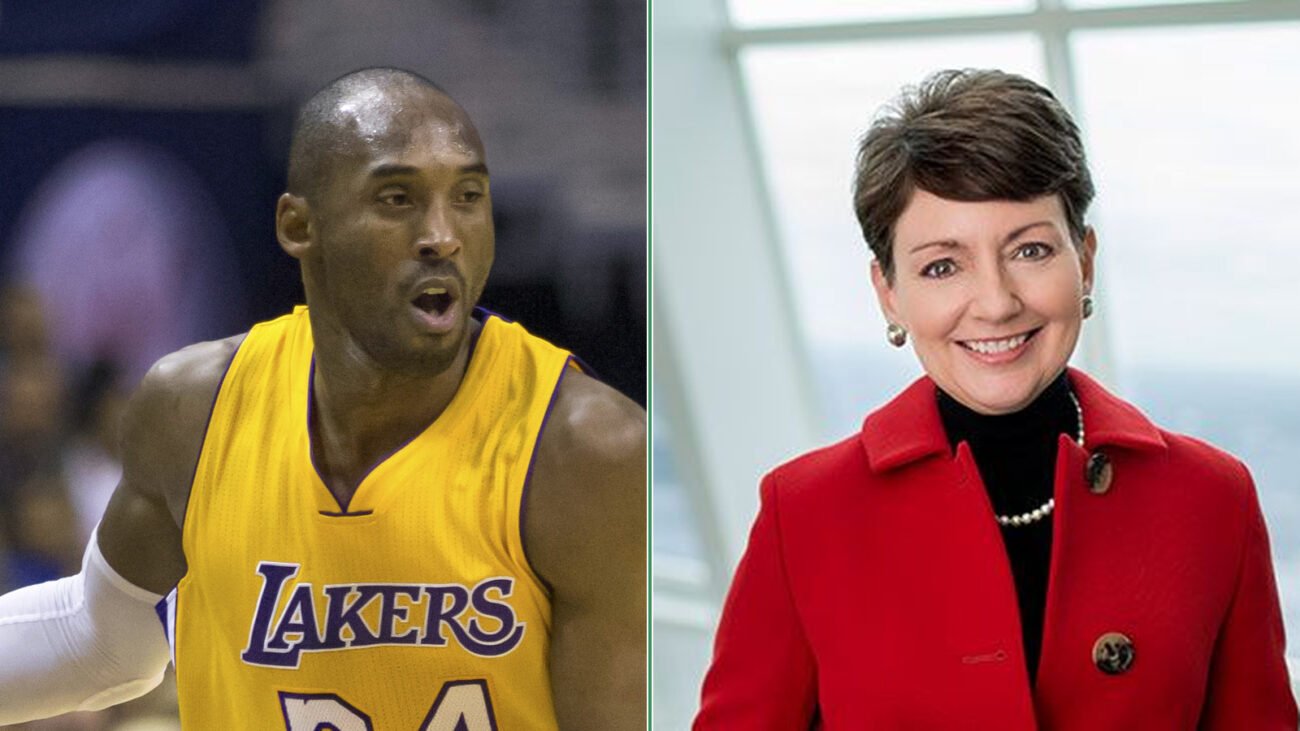
Keith Allison (source edits: JoeJohnson2; CC BY-SA 2.0, left panel); Duke Energy (news-media use). Cropped/resized.
Kobe Bryant was a five-time NBA champion whose entire playing career belonged to the Los Angeles Lakers. Lynn Good was the Duke Energy chief executive who led the company for almost 12 years before retiring in April 2025. Their names belong to different professional histories: one spans basketball and an Oscar-winning film; the other covers accounting, energy operations and corporate boards.
The clearest way to understand each is through the moments that changed their work. Bryant’s two jersey numbers mark distinct periods on the court. Good’s changing titles and company transactions show how her responsibilities developed, and when they passed to someone else.
Bryant’s journey to Los Angeles
Bryant’s basketball education began well before his NBA debut. Born in Philadelphia, he spent much of his childhood in Italy while his father, Joe Bryant, played professionally there. The family returned to the United States before Kobe’s high-school career. He then went directly from school into the 1996 NBA draft, without playing college basketball.
Charlotte selected Bryant with the 13th pick and traded him to the Lakers. That distinction sometimes gets lost in the shorthand of a one-team career: Los Angeles was the only NBA franchise he played for, but it did not draft him.
The championships arrived in two runs. The Lakers won three consecutive titles in 2000, 2001 and 2002, followed by consecutive wins in 2009 and 2010. Bryant’s career therefore stretched across separate championship teams, rather than a single brief period of dominance.
What the two Lakers jerseys represent
Bryant wore No. 8 before switching to No. 24 for the 2006–07 season. The Lakers eventually retired both numbers, holding the ceremony on 18 December 2017.
The numbering helps place familiar highlights in order. His 81-point game against Toronto on 22 January 2006 came during the No. 8 years. His 2007–08 regular-season MVP award and the 2009 and 2010 Finals MVP awards came after the switch.
His last game also belonged to the No. 24 period. On 13 April 2016, Bryant scored 60 points as Los Angeles defeated Utah 101–96. That evening ended a 20-season NBA career; the jersey ceremony followed the next year. Retirement from competition and the team’s formal tribute were separate events.
Reading Bryant’s career numbers
The NBA’s retirement summary lists 33,643 regular-season career points, 18 All-Star selections, eleven All-NBA First Team selections and nine All-Defensive First Team selections. It separately records 5,640 playoff points.
Those categories answer different questions. The points totals describe scoring over many seasons. All-NBA and All-Defensive selections recognise season-long performance, while Finals MVP honours relate to a particular championship series. Combining everything into a single trophy count would obscure those differences.
Historical rankings also need their dates attached. The NBA’s 2016 release placed Bryant third on its all-time scoring list at the time. His own total is fixed, but other players’ careers continued. A retirement-era ranking should not automatically be presented as today’s table.
Bryant died on 26 January 2020. The Naismith Basketball Hall of Fame includes him in its Class of 2020.
The film that followed basketball
Bryant used the end of his playing career as the starting point for Dear Basketball. His farewell poem became an animated short, narrated by Bryant, directed and animated by Glen Keane, and scored by John Williams.
The story moves from childhood ambition towards accepting the end of a playing career. That makes it a personal account of basketball, presented through a new medium. Bryant supplied the writing and voice; animation and music were central to how the story reached the screen.
At the 2018 Academy Awards, the film won the animated short category, with Keane and Bryant named as recipients. The ceremony took place on 4 March 2018. It recognised a completed film, adding a creative achievement to a public record already dominated by sport.
Good’s move from finance into utility leadership
Good’s route to chief executive began in accounting. Before entering the energy industry, she spent two decades in senior management and partner roles at Arthur Andersen and Deloitte & Touche. She joined Cinergy, a Duke Energy predecessor, in 2003.
Her subsequent responsibilities went beyond accounting. As head of Duke’s Commercial Businesses organisation, she oversaw areas including non-regulated generation, international operations, renewables and mergers and acquisitions. In July 2009, she became executive vice president and chief financial officer.
Duke appointed her president and CEO effective 1 July 2013. The chair role came later, in 2016. These were distinct appointments: her time running the company began before her time chairing its board.
A larger natural gas business
One major transaction during Good’s tenure was Duke’s acquisition of Piedmont Natural Gas, completed on 3 October 2016. Duke’s completion announcement said Piedmont brought one million natural gas customers into the group, alongside Duke’s existing 525,000 gas customers at that time.
Piedmont retained its name and became a Duke business unit. The company said it would integrate corporate functions such as accounting, human resources and IT, while customers would initially keep their existing billing and service arrangements.
That distinction is useful when reading about acquisitions. Ownership can change while a familiar customer-facing name remains. The announcement documents the structure of the deal and its immediate arrangements; it does not, by itself, prove every benefit the companies expected from the combination.
A shift in Duke’s business mix
The company’s portfolio changed again later in Good’s tenure. On 25 October 2023, Duke announced the completed sale of its unregulated utility-scale Commercial Renewables business to Brookfield. Good described it as the last step in Duke’s move to a fully regulated utility.
The announcement concerned a particular business, not an exit from every form of renewable generation. Duke said it intended to invest in renewables within its regulated operations and in grid improvements. It also planned to use the sale proceeds to strengthen its balance sheet.
The acquisition of Piedmont and the sale to Brookfield show two sides of a chief executive’s work: adding businesses and deciding which activities should leave the group. Neither transaction can be understood from the company name alone.
The 2025 leadership handover
Good’s Duke chief executive tenure ended on 1 April 2025, when Harry Sideris took over and joined the board. Sideris had already been president since April 2024 and retained that position.
Ted Craver became board chair on the same day. Good had held the CEO and chair jobs together, but the succession divided those responsibilities between two people.
The dates explain why older descriptions can be misleading: Good’s presidency ended in 2024, while her CEO and chair service continued into 2025.
Good’s work beyond Duke
Retirement from Duke did not end Good’s board work. As checked in October 2026, Boeing’s director biography listed her as a director since 2015, chair of its Compensation Committee and a member of its Audit Committee. It also listed Caterpillar and Morgan Stanley among her other current public-company directorships.
For Bryant, the later chapter included turning his own retirement into a film. For Good, it includes board responsibilities after leaving executive management. Each career has a documented sequence of roles and milestones worth understanding on its own terms.
Sources: NBA, the Basketball Hall of Fame, the Academy, Glen Keane Productions, Duke Energy and Boeing. Checked 2 October 2026.

